Content Engineering for High-Growth Brands: The Architecture of Authority
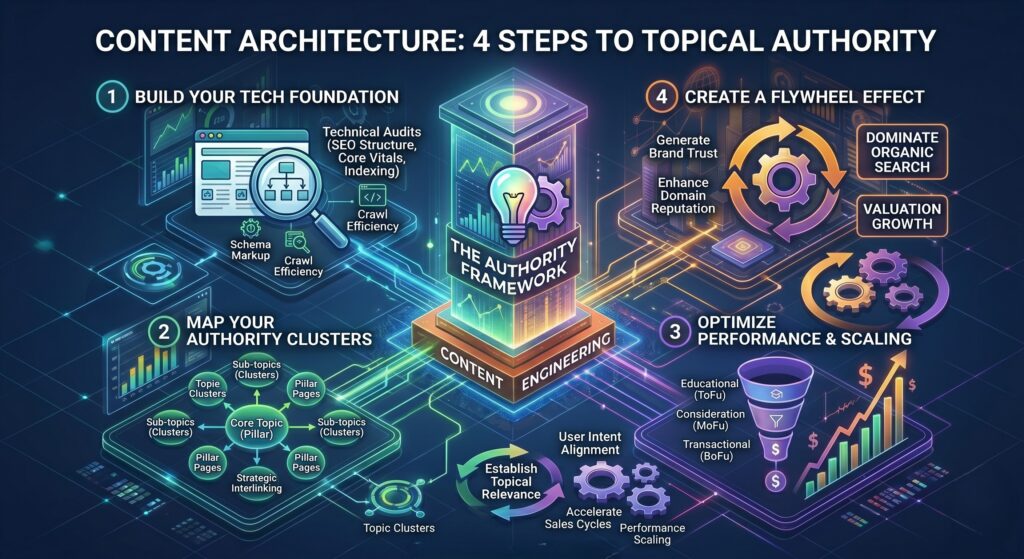
Stop producing content that just fills space. In the high-stakes world of digital growth, “more content” is rarely the answer. In 2026, the brands that dominate their markets aren’t just publishing—they are engineering their organic presence.
Technical Audits
Identifying the structural gaps that prevent search engines from trusting your domain.
Authority Mapping
Building a content ecosystem that establishes your brand as the primary reference point.
Performance Scaling
Refining content to match user intent and accelerate the sales cycle.
The Paradigm Shift: From “Marketing” to “Engineering”
Content marketing, as traditionally defined, is a campaign-based pursuit. It focuses on reach, social shares, and vanity metrics. Content Engineering, however, is a discipline of infrastructure. It treats your website as a digital asset that must be built with the same precision as a piece of software or a high-performance engine.
For high-growth brands, the difference is stark. A campaign-based approach might generate a spike in traffic, but an engineered approach generates a compound interest effect. When your content is engineered, every new piece you publish makes your entire library more valuable, creating a “flywheel” of authority that competitors cannot easily disrupt.
Phase 1: The Technical Foundation
Before you pen your first headline, you must address the hidden reality of your domain. Google’s crawlers are efficiency-driven; they prioritize sites that provide a seamless, rapid experience. Technical debt—broken links, slow load times, and messy site structures—is a “trust tax.”
The Anatomy of a Technical Audit:
- Structural Taxonomy: Is your site organized by logical parent-child relationships? Search engines use your URL structure to understand the importance of your pages.
- Crawl Budget Optimization: Are you wasting Google’s time by letting it index low-value pages? We prune the “bloat” to ensure crawlers focus on your high-intent revenue drivers.
- Semantic Integrity: Do your pages use Schema markup? High-growth brands must communicate in the language of machines, using structured data to help search engines understand the context of their business.
Phase 2: The Art and Science of Authority Mapping
Topical authority is the currency of 2026. You cannot rank for “High-Growth Strategy” simply by writing one article. You must prove depth.
The Cluster Model: We design a “Pillar Page”—a massive, comprehensive guide on a core subject—and surround it with a satellite network of specific, long-tail articles. Each satellite page links back to the Pillar, funneling “Link Equity” to the center. This creates a web of relevance that Google finds impossible to ignore.
Phase 3: Scaling Performance via User Intent
Traffic is only valuable if it is qualified. Most brands make the mistake of creating content that attracts curiosity-seekers rather than decision-makers. Content Engineering re-aligns your output to the specific stages of the buying cycle:
- Top of Funnel (Educational): Solving problems, not pitching solutions.
- Middle of Funnel (Consideration): Comparing methodologies and demonstrating why your framework works.
- Bottom of Funnel (Transactional): The final push, addressing objections and providing the evidence needed to convert.
Why This Matters in 2026
The cost of customer acquisition through paid channels is reaching a breaking point. When you rely solely on ads, your growth is tied directly to your budget—the moment you stop paying, the leads stop flowing. Organic search, once engineered, becomes a permanent, self-sustaining stream of high-intent traffic.
Investing in your Content Architecture is an investment in your brand’s valuation. It is the difference between being a brand that shouts the loudest to be seen, and a brand that search engines instinctively point to when a customer has a need.
Ready to Engineer Your Growth?
Don’t let your domain remain an under-optimized asset. Join the brands that have shifted from “marketing” to “building.”